
We continue with our posts of extracts published in the City Press several years ago.
Most of the writings in the Ancestral Voices Collection relate to history or social practices. Of the 342 writings currently uploaded into the collection, 26 relate to medicine or the treatment of spiritual, psychological and physical illness; 13 relate to metalworking; while 10 detail the practices of woodcarving, leatherwork and pottery.
The writings on medicine are extensive, dealing with the plants used and the traditional techniques practised before colonisation.
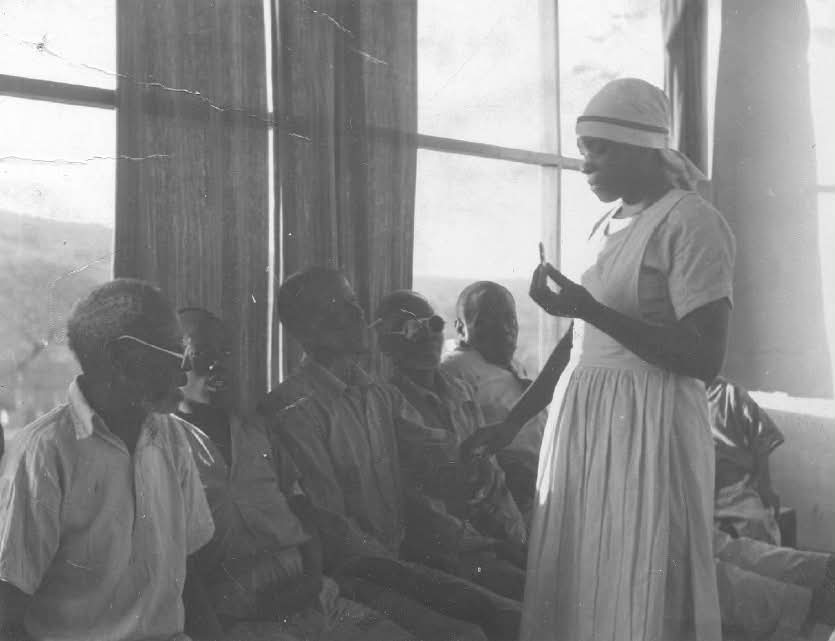
The image of a nurse treating her patients at the Donald Fraser Hospital just outside Thohoyandou in Vhembe Limpopo illustrates well the changes traditional medical practitioners would face with the arrival of mission hospitals.
TSONGA MEDICAL LORE. WRITTEN BY NBAMBI J (1907 – 1987) IN XITSONGA IN THE 1930S
‘I would like to thank God for affording me the opportunity to rummage through the ancient life of our ancestors in respect of medical lore.
Greetings all. I am Muhlave Makuhani Matsevele Ndhove. I am from Gondzhwanda under Savi (Hlengweni, Portuguese east Africa). My grandparents came to the Transvaal at Maxawu village, fleeing wars with the Nguni people.
I would like to narrate matters relating to ancestral traditional healing. I would also like to inform you about the secrets relating to ancestral traditional healing, that is, before our encounter with the white man. Some of these secrets are now meaningless and have fallen out of practice.
However, some traditional healing practices remain significantly important, even today. As a result, some go beyond the proverbs of the ancestors. In modern times, there are white physicians who are much more educated with regard to medical treatment than our grandparents. Therefore, this is strictly just a commentary on traditional healing.”
Four of the 26 writings that speak of medicine focus on the practice of diagnosis by throwing bones. This varies slightly from clan to clan and nation to nation, as can be seen in the following extract:
MEDICINE MEN AND PRACTICES. WRITTEN BY LEDWABA M E IN SESOTHO SA LEBOA IN 1940
‘Divining bones are made from the animals that were killed when rituals were performed. Not every animal bone was used for divining.
The traditional healer would do research and identify the prospective customers. He/she would want to know the totem used by most of his/her customers before he/ she could kill the totem animal. It is believed that the bones of a totem animal are able to predict, diagnose and prescribe traditional medicine for the patient. In most cases, these bones help the traditional healer to know about the witches in the villages.”
How long have indigenous South Africans been working with metal, and what did they make? At least 13 of the 342 Ancestral Voices writings talk about the indigenous metalworking, as in the following extract:
CUSTOMS AND HISTORY OF HLENGWE AND NEIGHBOURING VENDA. WRITTEN BY MABALE N J (1918 – 1999) IN XITSONGA IN THE 1930S
‘I am Masianuga Xikukuvi, wa Mtamba, wa Netshisekoni. Vhatavhatshindi muye mutshila wa mbudzi ntsumbu wayo vha tshila.
We would make fire, which would generate red-hot embers, which we would use to smelt (fula) hoes. The firewood gathered would be piled up to the height of a house or even higher.
Once the firewood produced the embers, women were asked to pick up or collect the embers … which were taken to the smelting furnaces (marhurhweni). Then we, together with some women, would get to Ximbupfe to dig and extract iron-bearing rocks (ngwidi, ngwedi in Tshivenda).
The women would winnow the ngwidi and selectively separate it from the ore. They would then carry it with wide-bottomed baskets and large conical baskets to the smelting furnaces. The ore was taken to the smelting furnaces, where a hole with a conical shape was dug – next to the smelting furnace. The ore was plunged into the hole.
Fire was then made for the ore to come together into one mass and become sufficiently cooked, softened and refined. The ore would be kept in the fire in the hole the whole night. Then it was taken to the smelting furnace where we worked until sunset. When we left the smelting furnace in the evening, we were pitch black with soot.
Once the ore was in the smelting furnace, an expert was summoned with the chemicals to put into the smelting furnace so that the ore could come out as solid iron. I had learnt the skills to do this job from my father, who used to do it himself.”
The 10 writings detailing the craft and material culture (with more writings being translated currently) are an amazing collection of techniques and styles, differing by clan or family. The names of the famous craftsmen and women are part of the deep knowledge handed down from generation to generation.
PEDI MATERIAL CULTURE. WRITTEN BY MOSEHLE A IN SESOTHO SA LEBOA IN 1945
‘Mogopo, a wooden bowl for serving porridge, is crafted by men from a trunk of a morula tree. Not all men are able to craft it. But there are men who are able to craft this traditional bowl. Among them are the likes of Moubane Mawela, Hlabane Mohlala and Mmara Thuke.
They use an axe to craft it and a special iron tool known as petlo to make it hollow. A knife is used to make it smooth. When the crafting is done, they make some patterns on its edge by using a hot rod.
In many cases the patterns are black lines that are carefully drawn on the edge of the utensil.”
Other writings include descriptions of pottery techniques, basket-weaving and leatherwork, often with hand-drawn illustrations of the objects described.
Leave a Reply